
Root River Watershed Sees Gains, Sets Priorities for Next Decade
Officials report reduced sediment and nutrient runoff while shifting focus to groundwater protection, flooding and soil health

Our stories are shared with you free of charge. They’re stories that connect you to neighbors, powered by readers like you.
SOUTHEASTERN MINNESOTA – Sheathed by craggy, crumbled ice-snow as it flowed past Hokah recently, the Root River’s waters were unseen, inscrutable.
But experts do know a lot about those waters, including that they are a bit cleaner than they were 10 years ago, and are on a course to be better yet in the next decade.
For example, officials from counties, state and private groups that are involved in the Root River’s first 10-year One Watershed One Plan know that even after about five years of the first plan, which is now ending, there were improvements.

Nikki Wheeler, Fillmore County Soil and Water Conservation District water management coordinator, working on the new One Watershed One Plan for the Root River. (Photo by John Weiss)
Local partners in the watershed implemented 487 best management-practices projects, resulting in 12,000 fewer tons per year of sediment, 38,000 fewer pounds per year of nitrogen and 14,000 fewer pounds per year of phosphorus going down the river.
Other highlights were a 28-foot-tall flood-control dam to help slow high water on the Crooked Creek Watershed (southeast corner of Houston County) which is part of the plan, and 45-acres of prairie strips in the western-most reaches of the Root watershed in Mower County.
The Root River watershed, one of the first of several dozen Minnesota watersheds to have such a plan, covers about 1.4 million acres of the Root Watershed itself, as well as parts of the Upper Iowa River Watershed and the Crooked Creek Watershed in the southern part of the area.
It is an unusually varied watershed, beginning in the flat farmlands of eastern Mower County, then dropping into the sinkholes of the middle karst area and finally into the lower karst area which has fewer sinkholes.
The river blends into the Mississippi River south of La Crescent.
“It has its challenges,” said Nikki Wheeler, water management coordinator for the Fillmore County Soil and Water Conservation District (SWCD). Fillmore SWCD is the plan’s fiscal agent.

Turkeys eat waste from a picked cornfield near Brownsville. Keeping such vegetation on the land improves water quality. (Photo by John Weiss)
The plan covers parts of Mower, Dodge, Olmsted and Winona counties, nearly all of Houston County and all of Fillmore County.
One Watershed One Plans are a holistic push to improve Minnesota land and water. Individual counties once received their own funding and tried to manage their problems. But “water doesn’t care about county boundaries so we’ve moved to watershed planning scale,” she said.
Maybe water in a county river has high sediment load but it’s coming from upstream land so that the county can do little to clean its water. The new plan would put more time and money into solving that upstream problem.
Wheeler spoke Jan. 26 after an all-morning meeting of many of the groups as they brainstormed for the second 10-year plan.
A few things came out of the meeting, such as that ground water quality will continue as the main focus in part because the karst topography has little topsoil covering fractured aquifers below. What is on surface soils can be in the water within days, even minutes. And what’s in the ground can come out in tens of thousands of springs and seeps.

Anglers would have better trout fishing with improvements from the Root River Watershed plan. (Photo by John Weiss)
Also, most of the problems are interrelated, so keeping soil on farmland keeps it more productive but also means cleaner water; the river will be better for recreation and trout streams better for fish and fishing; less nitrogen going into ground water means better drinking water coming out.
There was also an insistence that the new plan be “easier to use, easier to understand,” Wheeler said.
“Our original plan is hard for the staff to use,” Wheeler said. Imagine what it was like for a landowner to use, she said.
“Our plan is for 10 years but it doesn’t mean our work ends at 10 years,” Wheeler said. “We update, we keep going.”
For example, the 12,000 tons of sediment reduction is about 10 percent of what the first report said was a total of 116,416 tons per year. The ultimate goal is to drop the sediment load by 52,387 tons, or about 45 percent.
And new issues might arise, she said. “If there are emerging issues, we pivot and work toward those.”
Another problem is that the region is getting 1.68 more inches of precipitation annually so there is more water to contend with. Experts also warn that damaging, large amounts of precipitation coming in one strong storm are also rising.
At that meeting, experts said areas that need emphasis include nutrient management, manure and water storage, cover crops and perennial covers, crop rotation and diversification, well sealing, septic updates and a well inventory.
Also suggested was going into classrooms to help the younger generation understand the problems.

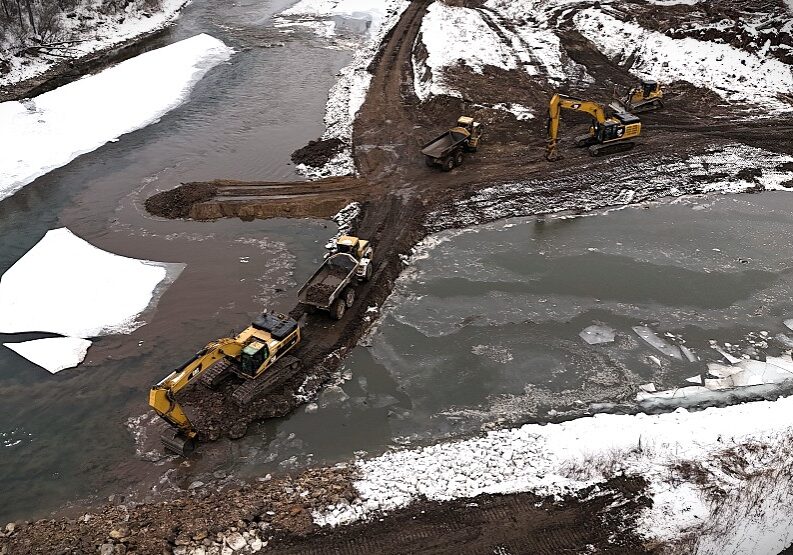
Trout Stream in Houston County showing erosion damage to streambanks due to extreme storm events. Photo taken prior to the streambank repair project. (Photo by Root River SWCD)
Riley Buley, Fillmore County SWCD district administrator, said the group has until the end of the year to finish.
He agreed that ground water will continue to be a big priority. Nitrate levels are a key indicator of how good that water is and “we’re not seeing a trend either up or down,” he said.
Some biological impairments such as E coli are also present as is mercury, he said.
Another of the problems facing the watershed is the past, he said. “The issues that happened decades ago could be showing up in our ground water (today),” he said.
As for funding, Buley said it’s been good to see the plan’s money, which comes from the state, has been leveraged with private, federal or other state programs. That leveraging helps get better soil management for tens of thousands of acres, he said.
“I think people are definitely answering the call to make those improvements on the landscape.”
A-level priorities for the second 10-year plan, agreed upon Jan. 26, 2026: B-level priorities: View the original Root River One Watershed, One Plan here.
Contributor
Share this story


Subscribe Free
Receive Root River Current’s latest articles, newest community voices, area photos and more in our weekly e-newsletter!
Follow us


Supported by...