
Restoration Project Redirects Root River to Original Channel
It may look—and flow—differently than it did a year ago, but it’s still the same river!

Together, Shaping Our Future.
Thank you to all who contributed to Root River Current during our third anniversary campaign, wrapping up with the first-ever Minnesota Local News Giving Day, April 30th. Your support is what powers us into our fourth year of publishing stories that matter to Southeast Minnesota.
Psst! If you haven't yet made your gift, you still can. But don't just think about it—do it...right now!
CARROLTON TOWNSHIP, FILLMORE COUNTY—Despite this spring’s storms, downpours and seasonal runoff, Southeast Minnesota’s Root River has generally been running a bit below bankfull—but still at a healthy clip, teasing canoers, kayakers and anglers who have been waiting months to get back on the river.
And for the most part, these water-bound recreationalists are finding the river follows the same course it’s been following for years—unless you’re on the Root north of Lanesboro, adjacent to the Eagle Bluff Environmental Learning Center (ELC).
Work there has been underway since late 2024 to move a portion of the river back to its original channel—no small feat—and to strengthen its banks and recreate its floodplain further downstream. Given the progress on these restoration efforts, both areas today look visibly different than the way they looked just two years ago.

The Root River’s rechanneling work (shown in red) is complete heading into the summer of 2026. (Image by G-Cubed Engineering)
Rerouting the river
This past winter, the Root River Restoration Project completed its final phase of construction, marking the return of the river to its original channel for the first time since it was altered by a hydroelectric dam in the early 20th century.
This work was completed in December 2025 by the Fillmore County Soil and Water Conservation District (SWCD) and Minnesota Department of Natural Resources; the project was funded by the Environment and Natural Resources Trust Fund as recommended by the Legislative-Citizen Commission on Minnesota Resources.
This pivotal step marks the culmination of years of planning and phased construction aimed at addressing severe bank erosion, excess sedimentation, and degraded aquatic habitat.

Onlookers (on left) watch from the shoreline as load after load, an excavator dredges up mud and silt from a dike, gradually opening the way for the Root River’s icy current to move into its new channel. (Photo by Colleen Foehrenbacher)
In a carefully coordinated effort, work crews used heavy machinery to redirect the river’s flow from the existing channel into the newly reconstructed one. The diversion process took approximately four hours to complete, reconnecting the river with its historic path along the bluff (watch the video below for a shortened version of the process).
Following the diversion, crews spent the next month completing critical earthwork to stabilize the site. This included building up and reinforcing the new riverbanks and sealing off the downstream portion of the former channel. These efforts ensure the long-term integrity of the restored channel while reducing the risk of future erosion.

The Root River’s current slowly flows into its new channel between carefully restored riverbanks. (Photo by Colleen Foehrenbacher)
Importantly, the former river channel will not be lost. Instead, it will remain as a wetland feature that will provide valuable floodwater storage during high flow events, reducing pressure on the restored riverbanks, and creating important habitat for wildlife. This dual benefit supports both ecological resilience and watershed health, aligning with regional priorities identified in the Root River One Watershed One Plan.
With the river now flowing along its original course, the project enters a new chapter focused on long-term monitoring and habitat establishment. Native vegetation along the restored banks will continue to mature, further stabilizing the soil, improving water quality, and enhancing habitat for fish, macroinvertebrates, and other wildlife.

Reconstruction of the Root’s riverbank reduced steep drop-offs, expanding its natural floodplain. (Photo by Colleen Foehrenbacher)
Strengthening the banks
Approximately two miles downstream, additional restoration work led by Eagle Bluff Environmental Learning Center has focused on streambank stabilization and habitat recovery.
This phase of the project, also funded by the Environment and Natural Resources Trust Fund and the U.S. Fish and Wildlife Service, builds on stabilization efforts completed in early 2025 on two sections of severely eroding bank.
As part of this work, a series of bioengineering techniques were used to restore stability and improve ecological function along the river.
One key technique was the use of “toe-wood,” which involves placing large trees or root wads along the base (or “toe”) of an eroding streambank. This structure helps absorb and redirect the energy of flowing water, reduces scour at the bank’s edge, and creates complex in-stream habitat for fish and aquatic organisms.
For this project, pine trees were removed and repurposed as toe-wood material, anchored into the bank to provide a stable foundation for long-term restoration.

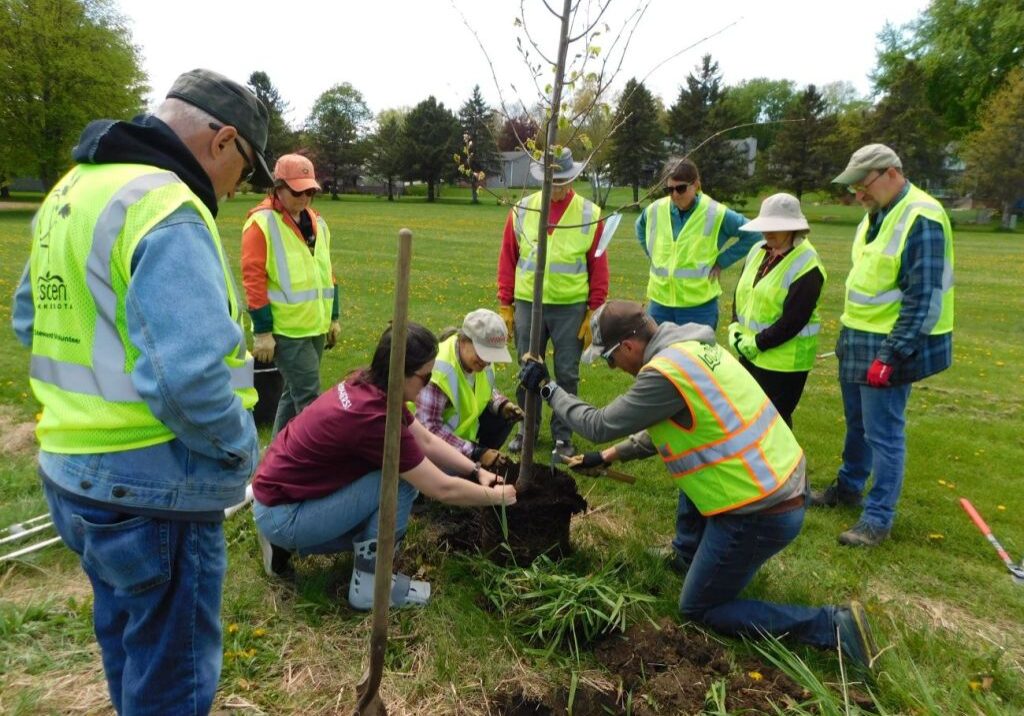
Eagle Bluff ELC staff and volunteers helped secure the Root River’s streambanks by planting hundreds of trees in 2025. (Photo by Colleen Foehrenbacher)
Following stabilization, Eagle Bluff ELC staff and volunteers planted more than 300 native trees and shrubs in the restored areas. These species were selected based on site-specific soil conditions and their value for wildlife habitat.
In addition, restoration areas were seeded with native prairie mixes to further stabilize soils, reduce erosion, and enhance habitat diversity for pollinators and other wildlife. The planted trees and shrubs achieved an estimated 80% survival rate, a success largely attributed to consistent rainfall throughout the summer and careful planting practices by staff and volunteers led by a certified arborist.
However, in August 2025, a major flood event, potentially a 500-year flood, caused a portion of the newly restored streambank to fail, washing out one section of the project area.
Additional construction work is planned for 2026 to repair the damage, including the installation of additional toe-wood and boulder structures. Efforts will again focus on rapidly establishing native vegetation to stabilize the bank and reduce vulnerability to future high-flow events.

With the passing of every year, these newly planted trees will provide the stabilization necessary to minimize flood damage along this stretch of the Root River. (Photo by Colleen Foehrenbacher)
Looking ahead, the project will continue for the next two years with ongoing monitoring of fish and macroinvertebrate populations, maintenance of restored banks and vegetation, and development of educational curriculum to support use of the site for school programs and adult ecotours.
The completion of this final phase represents a significant achievement for the Root River and its partners.
Together, these restoration efforts are expected to deliver lasting environmental benefits while strengthening the connection between the river and the surrounding community.
Paddlers beware!
Rechanneling the river has resulted in some new obstacles for paddlers and others navigating this stretch of the river.
To better manage the river’s current, deposits of rock and sediment—known as ‘riffles’—have been added to the new riverbed. Riffles typically result in shallower water flowing quickly over these rocky areas—often recognized by a wavy surface.
Because they can be dangerous to navigate, warning signs have been posted to call attention to these riffles, encouraging paddlers to portage around the area.
Moving a river’s main channel is no small task
The herculean work of bulldozers, excavators and other heavy machinery made it happen, as captured in the following video compilation by Colleen Foehrenbacher.
For more on the history of this project, read Root River Current’s Restoration Project: A Major Milestone Achieved and To End Erosion at a Former Dam, Engineers Shifting Root River Back to its Original Bed.
This story was edited for Root River Current by John Gaddo.
The Root River restoration project is a collaboration between Fillmore Soil and Water Conservation District, Eagle Bluff Environmental Learning Center and the Minnesota Department of Natural Resources. Funding for the project has been provided by Minnesota’s Environment and Natural Resources Trust Fund and the U.S. Fish and Wildlife Service through the Driftless partnership coordinated by Trout Unlimited.
Contributor
Share this story


Subscribe Free
Receive Root River Current’s latest articles, newest community voices, area photos and more in our weekly e-newsletter!
Follow us


Supported by...