
Essay | Summer, Spring, Winter and Fall, Water Calls to Us
Essayist stops to admire “something beautiful”

Our stories are free to read, but not to produce. As a nonprofit, we depend on your support to keep them available to everyone. Together, Shaping Our Future.
SOUTHEAST MINNESOTA—A famed 800-year-old poem by St. Francis of Assisi made me think more about water and a 10-year-old papal encyclical by another Francis – Pope Francis – and other writers made me realize I wasn’t thinking deeply enough about it.
Earlier this fall, I was asked to speak at a gathering celebrating St. Francis’ “Canticle to Creation” and Pope Francis’ powerful encyclical of the environments called Laudato Si, which are the first two words of the Canticle.
St. Francis’s canticle speaks of “Brother Son” and “Sister Moon,” but he also wrote “Praised be You, my Lord, through Sister Water, who is very useful and humble and precious and chaste.”
I would add that Sister Water is also eloquent and what water says we need to hear. At times, I’ve heard water call out its pain at what we are doing to it and our land. At other times, I’ve heard it soothe me with gentle riffling. Water is a mirror of the land and what is happening on the land.
What we can see in water
Let’s begin with what water has told me as someone who samples, tests and monitors it for eight programs, some weekly in summer, a few throughout the year. This part will deal with numbers and they aren’t looking good. Also, I deal only with surface water; drinking water is another subject but around southeastern Minnesota, the two are interconnected.
First, nitrates. A class of chemicals we’re hearing more about because they are being found in drinking water but they are also found in surface water. Nitrates are a danger to aquatic life, though from what I’ve read, it’s usually rather subtle. They are also a great bioindicator that other, possibly worse, chemicals such as neonicotinoids are in the water.

Volunteers test water samples along Mill Creek, a Root River tributary that flows south through Olmsted County into Chatfield. (Photos by Laurie Byrne)
Testing for nitrates in water is rather easy and I’ve monitored the South Branch Middle Fork Zumbro River west of Rochester for the Citizens Water Monitoring Program for more than 23 years. I also take a weekly sample in warm weather to Olmsted County to be tested for nitrates and other chemicals.
During the first four years of testing, the nitrate level exceeded the federal drinking water standard of 10 parts per million (ppm) just once, coming in at 10.2 ppm. In 2024, 10.2 ppm was the average and so far this year, it’s averaged a bit higher at 10.3 ppm.
And yes, this does vary with rainfall and other factors. During a flood, I took in a sample expecting really high numbers, but it was around 3 ppm or 4 ppm. Great, I assumed.
Ah, but the county water expert pointed out that the total flow was many times normal so total nitrates going to the Mississippi and Gulf of Mexico are actually much higher, so the one measurement alone doesn’t tell the whole story.
Nearly all nitrates doubtlessly come from ag because the river flows through the heart of heavily-farmed central Dodge County with few cities. But nitrates can also come from urban lawns and golf courses and many non-ag sources. This year, the Zumbro north of Rochester averaged about 6.2 ppm this year, only exceeding 10 ppm once.
Equally problematic is how dirty the water is. When I first started monitoring, I could see down my transparency tube an average of about 50 centimeters to 55 centimeters. In the past several years, it’s been closer to 35 centimeters. Of course, clarity depth changes with soils washed in during rainfall.
What’s the worst reading? I had a zero once during a record flood but I could only sample at a bridge between my two sites so it’s not official. But I have had 2s and 3s at my sites.
It’s more than ugly. A major study of the Zumbro found only 40 percent of the river met standards for bugs like mayflies and caddis flies. Why? I’m sure part is because dirt covers the critical riffles where the bugs live. This shrinks the web of life.

Neonicotinoids are suspected in bringing down numbers of pollinators such as butterflies. (Photo by John Weiss)
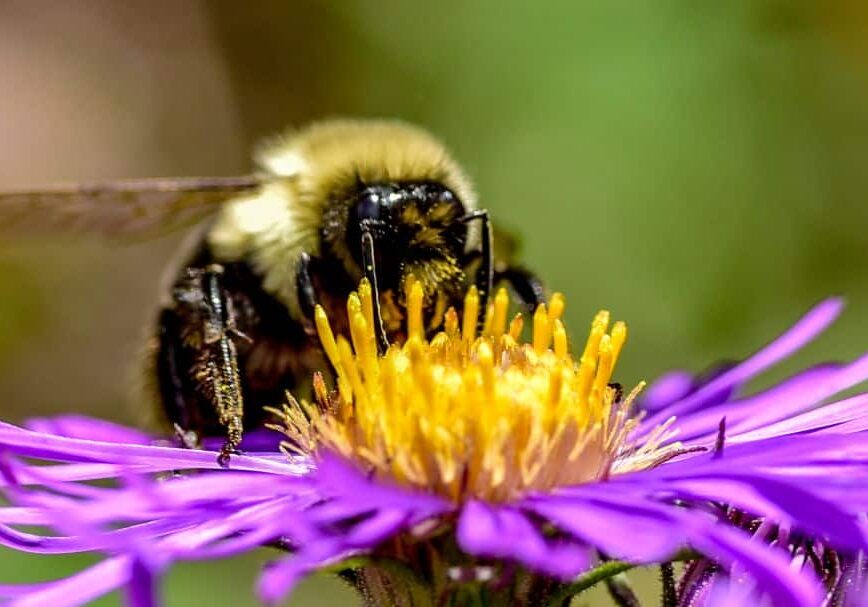
Finally, we’re seeing more problems with neonicotinoids, the most commonly used insecticide. It’s incredibly potent and is found on nearly every corn seed planted in Minnesota and most soybeans.
Minnesota’s Department of Agriculture (MDA) acknowledges that two chemicals – clothianidin and imidacloprid – are “surface water pesticides of concern” but won’t regulate them. They did develop Best Management Practices (BMPs) to protect pollinators and their habitat and there is a push to get the Minnesota Legislature to do more.
So, what can we do? You could check pesticides you buy for neonics, do more sampling, don’t let grass clippings or leaves get into sewers that flow into the river, keep plants on bare land to reduce turbidity, install rain barrels, use fewer lawn chemicals and report pollution.
Seeing beyond the numbers
The first step, however, I believe is to listen to the water, get close to it, feel it, see it. You protect what you love and I love moving water.

Fishing is one way of getting to better know water. (Photo by John Weiss)
In the past, I’ve told people the first thing they should do is fish, monitor, take pictures, learn to love and use that water. Notice I said “use.”
But since rereading Laudato Si and a few other favorite authors, I realized I need to see water with different, deeper eyes, I need to slow down, get more basic and let water speak to me. I can’t give you hard numbers on this as I can with nitrates and turbidity but I know it’s there.
Here are what a few favorite writers said:
Sister Miriam Pollard in her short essay “Forested” said of just letting nature speak: “Let the head rest, the famous and articulate brain. Let the heart hang up a sign in several languages, “Shhhh!… Let me plunk under a tree and agree to stop exploring – above all, try to stop trying to get out of the woods. Getting out of them is not the primary purpose of trees.”
Trappist Monk Thomas Merton: “No writing the solitary, meditative dimension of life can say anything that has not already been said better than the wind in the pine trees.”

Just enjoying beautiful water is a first step to helping it. (Photo by John Weiss)
Finally, Pope Francis: “If someone has not learned to stop and admire something beautiful, we should not be surprised if he or she treats everything as an object to be used and abused without scruple.”
I don’t want that to happen to me.
So, this summer, I did the unthinkable – I went to Olmsted County’s Root River Park and sat along the Root River. No fly rod, no camera, no Apple watch to tell me I was getting a good workout, no transparency tube.
Just me, a simple breakfast and the river.
I felt almost naked.
Contributor
Share this story

Subscribe Free
Receive Root River Current’s latest articles, newest community voices, area photos and more in our weekly e-newsletter!
Follow us



Supported by...